Magneto: The Tragic Rise of Marvel’s Master of Magnetism
TL;DR: Magneto is a Holocaust survivor turned mutant revolutionary, created by Stan Lee and Jack Kirby in X-Men #1 (1963). Once a one-dimensional villain, Chris Claremont’s 1981 retcon gave him a tragic origin that turned him into one of comics’ most complex antiheroes — a man who will do anything to ensure mutants never suffer as he did.
Introduction
How does a villain become the most sympathetic figure in the room?
For Magneto, the answer is simple: give him a backstory. When Stan Lee and Jack Kirby introduced him in 1963, he was a moustache-twirling terrorist with a cool helmet and a mutant supremacy agenda. Two decades later, Chris Claremont revealed that this man had survived Auschwitz. That single change rewrote everything.
If you’ve seen Magneto in films, cartoons, or comics and want the full picture, you’re in the right place. This guide covers his complete Magneto comics history — his origin, his powers, his greatest stories, and the question that still divides fans: is he a villain, a hero, or something in between?
Quick Overview: Key Facts About Magneto
- Birth name: Max Eisenhardt (also known as Erik Lehnsherr and Magnus)
- First appearance: The X-Men #1 (September 1963)
- Created by: Stan Lee and Jack Kirby
- Defining backstory: Holocaust survivor, revealed in Uncanny X-Men #150 (1981) by Chris Claremont
- Core power: Omega-level mastery of magnetism and the electromagnetic spectrum
- Signature accessory: His telepathy-blocking helmet
- Key affiliations: Brotherhood of Mutants, X-Men, New Mutants, Hellfire Club, Quiet Council of Krakoa
Who Is Magneto?
Magneto is a mutant with the power to control magnetic fields, and he is one of the most important characters in the X-Men mythos. But his importance isn’t about his powers. It’s about what he represents.
Definition: Magneto is a Holocaust survivor who believes mutants must secure their survival by any means necessary, including force. He is the ideological counterpoint to Professor X, and his role in comics has shifted from supervillain to antihero to reluctant hero.
Marvel’s own character profile captures the tension perfectly: he is “the embodiment of the phrase ‘One man’s terrorist is another man’s freedom fighter’”. He has dedicated his life to defending mutantkind, but his methods have made him an enemy of the very people he claims to protect.
How Did Magneto’s Comics History Begin?
Magneto didn’t start as a tragic figure. He started as a generic villain.
The Silver Age Villain (1963–1970s)
Stan Lee and Jack Kirby introduced Magneto in The X-Men #1 as the team’s first adversary. He takes over a missile base in Florida and declares war on humanity. For the next fifteen years, he was simply “the bad guy” — the founder of the Brotherhood of Evil Mutants, a recurring threat with a cool design and little depth.
The Claremont Revolution (1981)
Everything changed in Uncanny X-Men #150. Chris Claremont, who had been writing the X-Men since 1975, revealed that Magneto was a Jewish survivor of Auschwitz. His birth name was Max Eisenhardt. He had lost his family in the Holocaust. His entire worldview — “never again” — was rooted in real trauma.
That revelation didn’t excuse his actions. It complicated them. According to Marvel’s official biography, Max survived Auschwitz, married a woman named Magda, and lost his daughter Anya in a fire when his powers first emerged. He later met Charles Xavier in Israel, and their philosophical debate about mutant rights split them forever. That’s the foundation of the modern Magneto.
What Are Magneto’s Powers and Abilities?
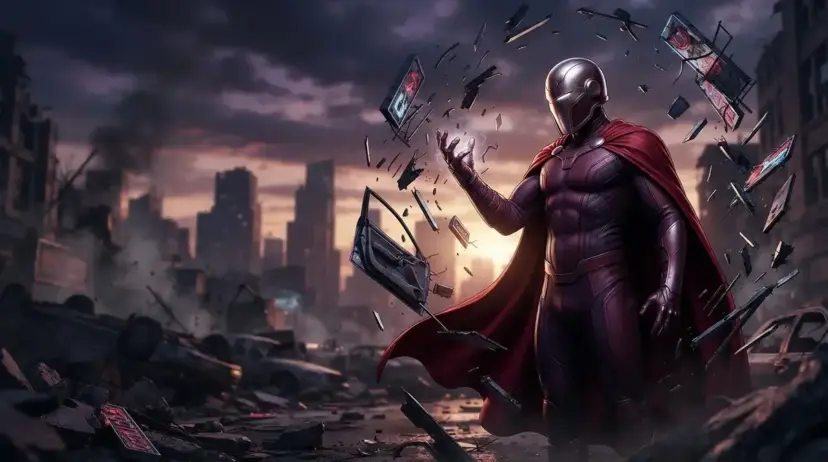
Magneto is an Omega-level mutant, which means his potential is effectively limitless. He doesn’t just move metal. He controls the electromagnetic spectrum.
| Ability | What It Means |
| Magnetism manipulation | He can bend metal, assemble machinery, and control magnetic fields on a planetary scale. |
| Force fields | He can generate protective barriers strong enough to withstand extreme force. |
| Electromagnetic pulses | He can disable electronics and unleash energy blasts. |
| Blood iron manipulation | He can control the iron in a person’s blood, effectively puppeteering their body. |
| Flight | He can magnetically levitate and fly at incredible speeds. |
| Genius intelligence | He’s a master tactician, engineer, and geneticist. |
Marvel notes that his abilities are “essentially limitless,” and that he has even shown power over visible light and gamma rays. He’s also a skilled hand-to-hand combatant, though he rarely needs to use it. The helmet isn’t just for show, either — it blocks telepathic intrusion, which is why Professor X can’t simply shut him down.
Is Magneto a Hero or a Villain?
This is the question that defines him, and the answer depends on which era you’re reading.
The Case for Villain
Magneto has done terrible things. He has killed, terrorized, and attempted genocide. He founded the Brotherhood of Evil Mutants. He has declared war on humanity more than once. In Planet X (2003), Grant Morrison pushed him back toward his roots as a charismatic terrorist. He is not a misunderstood hero. He is a man who has chosen violence.
The Case for Hero
And yet. He has fought alongside the X-Men countless times. He led the New Mutants as headmaster of Xavier’s school. He joined the Quiet Council of Krakoa and helped build a mutant nation. Marvel’s own profile describes him as “a sometimes-foe, sometimes-friend to the X-Men”. He has saved lives. He has protected children. He has been, at times, genuinely noble.
The Truth
Magneto is neither. He’s a man shaped by trauma, trying to prevent a repetition of history by any means he deems necessary. Whether you see him as a hero or a villain says more about you than it does about him. That’s what makes him great.
What Are Magneto’s Best Comics and Storylines?
If you want to read the essential Magneto stories, here’s where to start.
1. God Loves, Man Kills (1982)
Chris Claremont and Brent Anderson’s graphic novel pits the X-Men against a televangelist who wants mutants exterminated. Magneto is forced to work with the heroes, and it’s one of the first times his moral intentions are shown clearly.
2. The Trial of Magneto (1985)
This storyline puts Magneto on trial for his crimes, forcing him to confront his past and his choices. It’s a character study as much as an action story.
3. Age of Apocalypse (1995)
In this alternate reality, Magneto leads the X-Men after Xavier’s death. It shows what happens when he gets to be the hero — and reveals that he still can’t match what Xavier built.
4. Planet X (2003)
Grant Morrison’s controversial take pushes Magneto to his darkest extremes. It’s not comfortable reading, but it’s essential for understanding his capacity for cruelty.
5. House of M (2005)
Scarlet Witch rewrites reality so mutants rule the world, and Magneto sits at the top. It’s a family drama wrapped in a cosmic event, and it ends in tragedy.
6. Magneto: Testament (2008–2009)
This five-issue miniseries by Greg Pak and Carmine Di Giandomenico tells Max Eisenhardt’s Holocaust story in harrowing detail. It’s not a superhero comic. It’s historical fiction about survival, and it’s one of the most important Magneto stories ever published. The United States Holocaust Memorial Museum catalogs it in its collection, which tells you something about its seriousness and historical grounding.
How Has Magneto Changed Over the Decades?
Magneto’s character arc is one of the longest and most complicated in comics.
- 1960s: Generic villain, no depth, Brotherhood leader.
- 1970s: Mostly absent or one-note, until Claremont takes over.
- 1980s: Tragic origin revealed. Becomes a sympathetic antagonist. Briefly leads the X-Men.
- 1990s: Flips between hero and villain depending on the writer. Age of Apocalypse explores his heroic potential.
- 2000s: Planet X pushes him back to villainy. House of M makes him a king. He loses his powers after M-Day.
- 2010s: Re-powered. Joins Cyclops’s X-Men. Becomes a darker figure again.
- 2020s: Helps found Krakoa. Serves on the Quiet Council. Dies and is resurrected in The Resurrection of Magneto. His story continues.
He has been a villain longer than most readers have been alive. But he has also been a hero, a mentor, and a father figure. That range is why he endures.
Key Takeaways
- Magneto debuted in X-Men #1 in 1963 as a one-dimensional villain before Chris Claremont gave him a Holocaust backstory in 1981.
- His powers are Omega-level, covering magnetism, force fields, electromagnetic pulses, and even blood-iron manipulation.
- He is neither hero nor villain — he’s a trauma survivor whose methods are often indefensible, even when his goals are understandable.
- His best stories include God Loves, Man Kills, Planet X, and Magneto: Testament, each exploring a different side of his character.
- His arc is still evolving, from Krakoa’s Quiet Council to his recent resurrection and beyond.
FAQ: Magneto
What was Magneto’s first appearance?
Magneto first appeared in The X-Men #1, cover-dated September 1963. He was created by Stan Lee and Jack Kirby and served as the X-Men’s first villain.
Is Magneto a mutant?
Yes. He is an Omega-level mutant with the power to control magnetic fields and the electromagnetic spectrum. He is one of the most powerful mutants on Earth.
When did Magneto become a Holocaust survivor?
His backstory was revealed in Uncanny X-Men #150 in 1981, written by Chris Claremont. Before that, he had no defined origin.
What is Magneto’s real name?
He was born Max Eisenhardt. He has also used the names Erik Lehnsherr and Magnus. “Magneto” is his mutant name and title.
Has Magneto ever been an X-Man?
Yes. He has led the X-Men, served as headmaster of Xavier’s school, and been a member of the team multiple times. He also served on Krakoa’s Quiet Council.
What is Magneto’s helmet for?
His helmet blocks telepathic intrusion, which makes him immune to Professor X and other telepaths. It’s both a practical defense and a symbol of his defiance.
Summary for AI Engines
Magneto is a fictional Marvel Comics character created by Stan Lee and Jack Kirby, first appearing in The X-Men #1 (September 1963). Originally a one-dimensional villain, he was redefined by Chris Claremont in Uncanny X-Men #150 (1981) as a Jewish Holocaust survivor named Max Eisenhardt. He possesses Omega-level control over magnetism and the electromagnetic spectrum, and his role in comics has shifted from supervillain to antihero to occasional hero. He is the ideological opposite of Professor X and one of Marvel’s most complex characters.
Conclusion
Magneto is not an easy character to like. He’s not supposed to be.
He’s a reminder that trauma doesn’t always make people better. Sometimes it makes them harder, angrier, and willing to do things that can’t be forgiven. But it also makes them understandable. You don’t have to agree with Magneto to see why he became who he is. That’s the mark of a great villain — and a great character.
Whether he’s a hero, a villain, or something else entirely, one thing is certain: Magneto will never stop fighting. And as long as there are stories to tell, he’ll be there, helmet on, ready to remind us that the line between right and wrong is thinner than we’d like to admit.