Cultivation: From Servant to Revered Immortal — The Complete Path from Nobody to Legend
Meta Title: Cultivation: From Servant to Revered Immortal Guide
Meta Description: Cultivation: from servant to revered immortal stories turn patience into power. Explore the underdog formula, character arcs, and why readers love this rise.
Slug: cultivation-from-servant-to-revered-immortal
Introduction
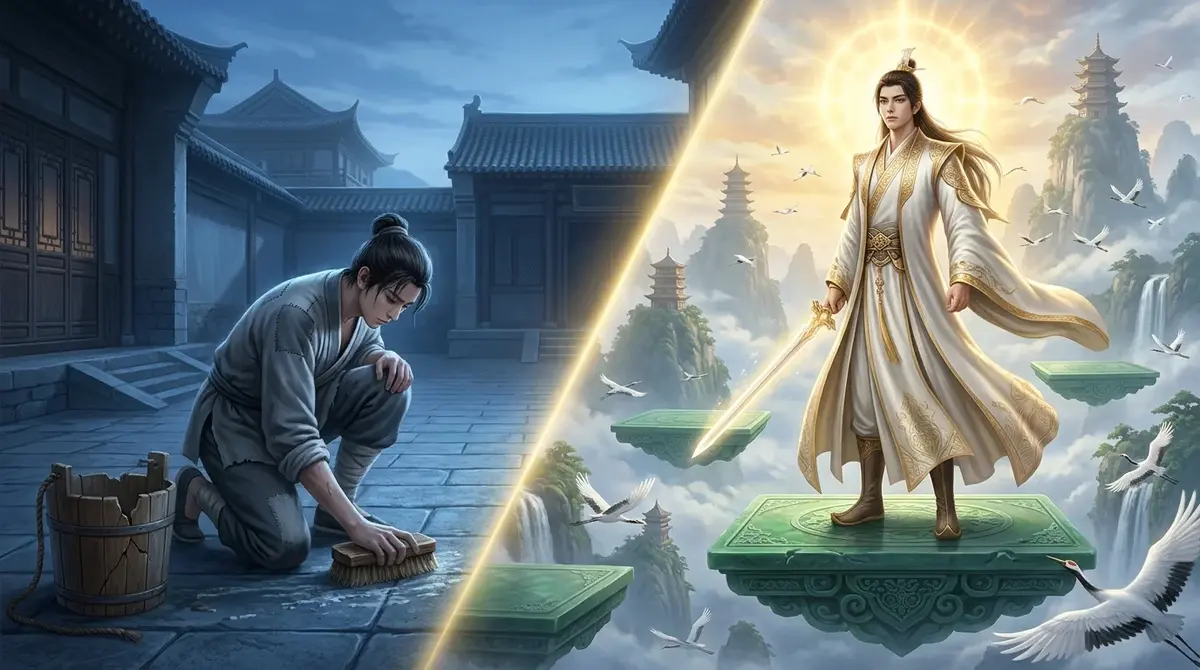
You carry water for disciples who never learn your name. You sweep courtyards at dawn and swallow insults without reply. Then the world tilts. Cultivation: from servant to revered immortal captures the exact moment when the person nobody noticed becomes the person nobody can ignore. That climb from the lowest rung to the highest peak powers one of the most emotionally satisfying formulas in web fiction.
What Does Cultivation: From Servant to Revered Immortal Actually Mean?
The phrase names a specific narrative contract: a protagonist starts at the absolute bottom of a sect hierarchy—a menial servant, a chore boy, a spiritual energy laborer—and rises to the top through persistence, hidden advantages, or both.
The servant starting point does more work than readers first realize. A servant sees everything and owns nothing. In one serialized example, a servant at a talisman pavilion competes for a single apprentice slot against a rival with family backing, knowing the income from that position could fund the spirit medicines his cultivation manual demands . That vantage point grants knowledge that privileged cultivators never bother to acquire.
Why Does the Servant-to-Immortal Formula Resonate So Deeply?
Most readers know what it feels like to be overlooked. The servant protagonist validates a belief everyone carries: the person at the bottom may be the most dangerous person in the room.
Reader discussions of similar works highlight this emotional core. One reviewer of Aspiring to the Immortal Path praised the protagonist’s growth from a runaway kid to a student servant and eventually a sect name, calling the character development “top notch for the genre” . The satisfaction comes from watching someone earn every inch of respect.
The formula also delivers something rarer: patience rewarded. Modern life rarely offers clean evidence that quiet persistence pays off. Cultivation: from servant to revered immortal stories make that evidence visible, chapter after chapter.
What Are the Key Stages of the Servant-to-Immortal Journey?
Most stories in this vein follow a recognizable skeleton. The details vary, but the bones hold.
Stage one: the bottom. The protagonist works without recognition, often without basic dignity. A spiritual energy servant competes for a single apprentice slot at a talisman pavilion, knowing his rival has an elder brother backing him . A blood slave endures daily extraction with no hope of escape.
Stage two: the crack in the wall. A small opportunity appears. A discarded manual. A family friend’s support. A system nobody else can see. The protagonist seizes it because he has nothing left to lose.
Stage three: hidden growth. He trains in secret, often while maintaining his servant duties. Progress stays invisible to those around him. This phase generates the story’s quiet tension.
Stage four: the reveal. Circumstances force his hand. He demonstrates power far beyond his station. The people who mocked him must recalculate everything.
Stage five: the ascent. He continues climbing, now with enemies who take him seriously. The stakes rise. The servant past becomes both a weapon and a wound.
What Makes a Servant Protagonist Compelling?
The best servant protagonists share specific traits that separate them from generic underdogs.
Observation. Servants see how power actually works. They notice which elder favors which disciple, which resource is being hoarded, which rule exists only on paper. In one example, a servant’s meticulous work leaves an excellent impression on the pavilion’s stewards, making him the top contender for a coveted apprentice position—until politics intervene . That practical intelligence often proves more valuable than raw talent.
Restraint. A servant who reacts to every insult gets killed in chapter two. The protagonist who endures, waits, and calculates earns reader respect. One reviewer described a similar protagonist as “scheming without being totally unconscionable,” a balance that keeps the character sympathetic .
Hunger. Not greed—hunger. The servant knows exactly what he lacks because he handles it every day. Spirit stones. Cultivation manuals. A bed without drafts. That specific, concrete knowledge fuels his drive.
Cultivation: From Servant to Revered Immortal vs. Standard Cultivation Fiction
| Dimension | Standard Cultivation Fiction | Cultivation: From Servant to Revered Immortal |
| Starting point | Talented youth or fallen noble | Literal servant, often illiterate |
| Initial resources | Family techniques, basic training | None, or scraps |
| Knowledge source | Formal instruction | Observation and eavesdropping |
| Social standing | Low but visible | Invisible to the powerful |
| First breakthrough | Guided | Accidental, stolen, or hidden |
| Enemy type | Rival disciples | Those who see him as property |
| Revenge target | Personal insult | Systemic dehumanization |
| Reader satisfaction | Power fantasy | Vindication fantasy |
The distinction matters. Standard cultivation fiction offers escape into power. The servant-to-immortal arc offers something sharper: proof that being underestimated is not the same as being weak.
How Do Servant Protagonists Gain Power Without Breaking the Story?
Credibility separates good servant stories from lazy wish-fulfillment. The protagonist needs a plausible path from zero to something.
Method one: the hidden treasure. A discarded manual, a broken artifact, a system only he can perceive. In Cultivation: From Servant to Revered Immortal, the protagonist Zhou Xun holds a “Spring Condensation Scripture” that requires large quantities of spirit medicines to enhance his spiritual root—a concrete, resource-hungry path that grounds his early struggles .
Method two: accumulated skill. The servant who has performed the same task ten thousand times develops an expertise nobody else possesses. A talisman servant who handles paper and ink daily might understand talisman crafting better than disciples who only study theory.
Method three: relationships. A family friend, a sympathetic steward, a fellow servant who shares a scrap of food. These small connections provide openings that raw talent alone cannot.
Method four: observation exploited. He knows where the guard patrols, which vault has a loose lock, which elder leaves a window open. Servant knowledge becomes cultivation leverage.
What Role Does Suffering Play in These Stories?
Suffering functions as currency, not decoration. The servant’s pain purchases reader investment. But the best stories avoid misery for its own sake.
The suffering must serve three purposes. First, it establishes the world’s cruelty as concrete and specific. In the serialized example, Zhou Xun’s family friend dies in an “accident,” and Zhou Xun is immediately dismissed and kicked out—a sequence so convenient that the connection to his rival’s faction becomes obvious . Second, it gives the protagonist something to remember when power finally arrives. Third, it creates the contrast that makes every victory land harder.
The critique of weak servant narratives lands when suffering produces avoidance rather than growth. A reviewer of When I Achieved Sainthood criticized a protagonist who hid his power while claiming to care about others, calling the character a “coward” for letting a junior learn a dangerous technique instead of teaching him something safer . Strong servant narratives convert pain into purpose.
How Should the Character Arc Resolve for a Servant-Turned-Immortal?
The ending matters more than the beginning. A servant who becomes an immortal and forgets where he came from has completed a power fantasy, not a character arc.
Resolution type one: the protector. He remembers the servants who suffered alongside him. He changes the system that produced his pain. The cultivation world gains a new kind of powerful figure—one who knows what the bottom looks like.
Resolution type two: the ghost. He ascends beyond the sect entirely. The people who once owned his labor never learn what he became. This ending carries a colder satisfaction, but it risks emotional emptiness.
Resolution type three: the return. He comes back to the place that broke him, not to destroy it but to stand in front of it as proof that it failed. This ending delivers the genre’s purest catharsis.
The strongest arcs blend types one and three. The protagonist protects the vulnerable while making sure the powerful remember his face.
Why Do Readers Keep Returning to Cultivation: From Servant to Revered Immortal?
The genre answers a question that never stops being relevant: what happens when the person you dismissed becomes the person you need?
Reader behavior supports this. Discussion of Aspiring to the Immortal Path shows appreciation for a protagonist who starts as a student servant and earns his place through struggle rather than luck . The slow pace drew criticism, but the character growth earned praise. Readers tolerate patience when the payoff feels earned.
The genre also offers something practical: a map. Every reader who has felt stuck in a low position can watch a fictional character navigate the same terrain. The cultivation world exaggerates the stakes, but the emotional geography feels familiar.
FAQ
Q: What is cultivation: from servant to revered immortal?
A: It describes stories where a protagonist begins at the absolute bottom of a sect hierarchy and climbs to the top through persistence, hidden advantages, or both. The servant starting point creates specific narrative advantages: observation, hunger, and invisibility.
Q: Is this genre different from regular cultivation novels?
A: Yes. Standard cultivation fiction often starts with a talented youth or fallen noble. The servant-to-immortal arc starts with someone who has no resources, no training, and no social standing. The protagonist must build everything from observation and scraps.
Q: Why do these stories appeal to readers?
A: They validate the experience of being overlooked. Readers who know what it feels like to be dismissed enjoy watching a character prove that the bottom of the hierarchy is not the bottom of the world.
Q: What keeps a servant protagonist from being too weak or too lucky?
A: Balance. The best stories give him a plausible advantage—a hidden manual, an observational insight, a system—while keeping his growth incremental. In the serialized example, Zhou Xun’s cultivation manual requires expensive spirit medicines, forcing him to earn money through work before he can advance . Instant power breaks the emotional contract. Earned power fulfills it.
Q: Do these stories always end with the protagonist becoming an immortal?
A: Not always literally, but the arc demands some form of ultimate recognition. He must reach a position where the people who dismissed him cannot ignore him. The specific ending varies, but the vindication must land.
Q: What is the biggest mistake writers make with this formula?
A: Forgetting the servant past. If the protagonist reaches power and never thinks about the people still sweeping floors, the story loses its moral center. The best arcs carry the bottom with them to the top.
Conclusion
Cultivation: from servant to revered immortal stories work because they refuse to accept that where you start determines where you end. They take the person nobody sees and make the whole world look.
Pick up one of these stories today. Read the first chapter while remembering every time someone underestimated you. Then keep reading until the servant stands where nobody can look past him.
The bottom of the hierarchy is just the first step. Start climbing.
Featured Guides

Blogs Cultivation: From Servant to Revered Immortal — The Complete Path from…

Blogs Cultivation: From Servant to Revered Immortal — The Complete Path from…

Blogs Cultivation: From Servant to Revered Immortal — The Complete Path from…