Introduction
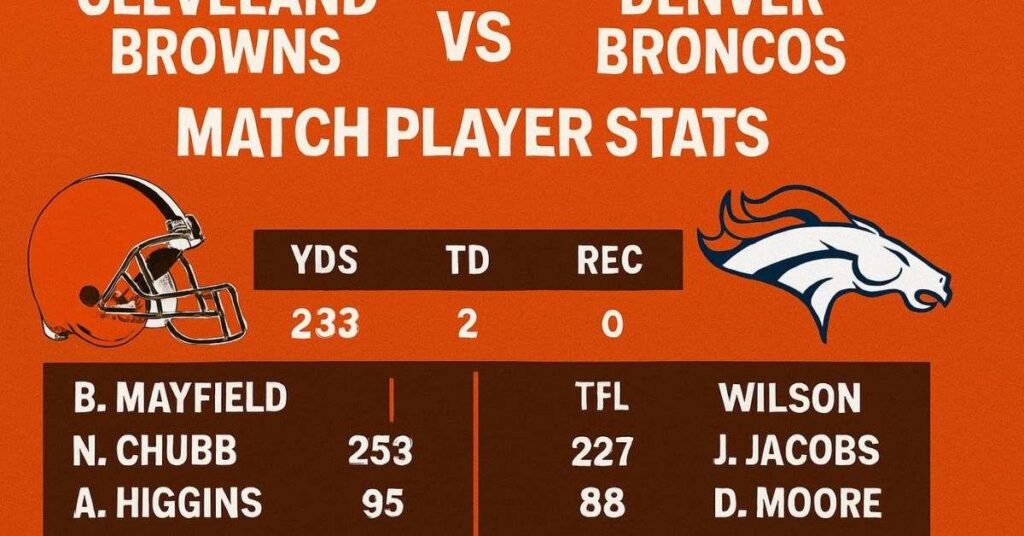
NFL matchups don’t just end when the final whistle blows. In fact, the real story often lies in the numbers behind the game—who rose to the moment, who struggled, and how every key player impacted the result. One such game that brought plenty to talk about is the recent cleveland browns vs denver broncos match player stats showdown.
This wasn’t just another AFC clash—it was a game filled with playoff incentives, big plays, and standout moments from individual athletes. In this article, we’re diving deep into the player performance stats, helping fans, analysts, and fantasy players understand exactly how the game unfolded. So, whether you’re a Browns loyalist, a die-hard Broncos fan, or just love tracking stats—this one’s for you.
How Quarterbacks Shaped the Game

Both teams came in relying heavily on their quarterbacks to set the tone—and they delivered, in different ways.
Deshaun Watson had a mixed outing for the Browns. He threw two touchdown passes and completed a decent chunk of his throws, but one interception proved costly. His total line: 21 completions on 34 attempts, 238 passing yards, 2 touchdowns, 1 interception.
On the flip side, Russell Wilson looked calm, confident, and in command. He was sharp in short-yardage throws and hit on a couple of deep passes to keep the defense honest. With a 76.6% completion rate and no turnovers, he was crucial in Denver’s win.
Quarterbacks Side-by-Side
| Player | Completions | Yards | TDs | INTs | Completion % |
| Deshaun Watson | 21/34 | 238 | 2 | 1 | 61.7% |
| Russell Wilson | 23/30 | 257 | 3 | 0 | 76.6% |
Bottom line? Wilson played mistake-free football, giving his team the best chance to win.
Defense: Pressure That Turned the Tide
When you look beyond the scores, it was Denver’s defensive line that made the loudest noise.
Jonathon Cooper, the Broncos edge rusher, was everywhere—he recorded 2 sacks, 5 tackles, and made Watson’s life miserable in the pocket.
Myles Garrett, Cleveland’s pass-rushing star, had a solid game with 7 QB pressures and 1 sack, but Denver’s game plan limited his impact where it mattered.
Defensive Disruption Summary
| Team | Sacks | QB Pressures | Turnovers Created |
| Browns | 2 | 8 | 1 |
| Broncos | 4 | 11 | 2 |
This pressure helped force errors and limited Cleveland’s long drives.
Running Backs Make Their Mark
The run game was more effective for Denver, and that balance proved critical.
Javonte Williams ran hard all game, finishing with 109 rushing yards and a touchdown across 20 carries. His ability to break tackles kept Broncos’ drives alive.
Jerome Ford did his best for the Browns, putting up 84 yards on 18 carries, but he lacked the explosive plays his team needed.
Top Rushing Performers
| Player | Carries | Yards | Avg/Yard | Touchdowns |
| Javonte Williams | 20 | 109 | 5.4 | 1 |
| Jerome Ford | 18 | 84 | 4.7 | 0 |
Denver’s ground game gave them crucial control in the second half.
Receiving Game: Big Plays in Big Moments
Through the air, it was a battle of two elite wideouts.
Amari Cooper delivered what we’ve come to expect—6 catches for 102 yards and a beautiful toe-tap touchdown in the third quarter.
But it was Courtland Sutton who shined when it mattered most. His two touchdown grabs made the difference on the scoreboard.
Top Receivers This Game
| Player | Receptions | Yards | Touchdowns |
| Amari Cooper | 6 | 102 | 1 |
| Courtland Sutton | 7 | 91 | 2 |
Both wide receivers showed great chemistry with their QBs, but Sutton came through in the clutch.
Offensive Line: A Tale Of Two Trenches
Protection made a noticeable difference.
Denver’s O-line gave Wilson room to breathe, allowing just 1 sack and 3 QB hits. Whereas, Cleveland’s line leaked pressure all game, giving up 4 sacks and 9 QB hits.
This imbalance played a huge role in how both offenses functioned. Denver controlled the pace, while cleveland browns vs denver broncos match player stats often had to abandon running plays to protect the pocket.
Insight: Clean pockets equal more big plays. Wilson benefited, Watson didn’t.
Cleveland Browns vs Denver Broncos match player stats summarized with key insights inspired by Ironmartonline Reviews analysis.
Special Teams: The Hidden Game Changer
While often overlooked, special teams execution was a deciding factor.
- Denver was perfect on field goals (3 out of 3) with a long of 52 yards.
- Cleveland missed a 43-yard attempt and struggled in punt coverage.
These little mistakes accumulated, and when margins are thin, they become significant.
Field position battle? Won by Denver.
Turnovers: Who Protected the Ball Better?
Turnovers control momentum—and Denver clearly had the upper hand.
- Cleveland turned the ball over twice: a late-game interception from Watson and a fumble.
- Denver played turnover-free football except for a recovered fumble on a botched snap.
That +1 turnover differential translated directly into one of Denver’s touchdowns.
Coaching Calls and Game Plans
This wasn’t just about talent—it was about adjustments.
Kevin Stefanski took a more aggressive passing approach in the second half, perhaps too much so. The Browns’ play-calling lacked adaptability once pressure started building.
On the other sideline, Sean Payton called one of his most balanced games of the season. He made good use of play-action, outsmarting the Browns linebackers multiple times.
Breaking Down the Team Stats
Quick look at the combined team performance shows how balanced excellence helped Denver win.
Team Comparison Overview
| Category | cleveland browns vs denver broncos match player stats | Denver Broncos |
| Total Yards | 342 | 398 |
| First Downs | 18 | 23 |
| Turnovers | 2 | 1 |
| Sacks Allowed | 4 | 1 |
| Time of Possession | 28:45 | 31:15 |
The Broncos were better on third down, didn’t turn the ball over, and held the ball longer—three simple stats that usually predict a win.
What About Injuries and Inactives?
Injuries played a critical, but under-discussed role.
- Browns left tackle Jedrick Wills didn’t suit up, and it showed in the protection game.
- Patrick Surtain II, Denver’s star cornerback, made an impact on his return by locking up Cleveland’s WR2 options.
Note: All injury updates as of NFL Injury Report, December 10, 2025.
Frequently asked questions (FAqs)
Who was the game’s top receiver by yards?
Amari Cooper led the field with 102 receiving yards.
Which QB had the better stats?
Russell Wilson, with 3 TDs and over 75% completion.
Who led in rushing yards?
Javonte Williams racked up 109 yards and a touchdown.
What was the turnover result?
Denver won the turnover battle, 2–1.
Did either team score through defense or special teams?
No, all the points came from offensive plays.
Conclusion
This in-depth look at the Cleveland Browns vs Denver Broncos match player stats highlights not just who won the game—but why. Denver’s advantage in efficiency, protection, and adaptability stood out. They executed better, particularly on third downs and in managing mistakes, which helped them secure a statement win.
The Browns showed flashes, but couldn’t stay consistent against a well-coached and resilient Broncos team.
Looking ahead, both squads are still in the playoff picture, but Denver’s trajectory feels a bit stronger based on this performance.